
Global equities are beginning to broaden out as market breadth improves and previously lagging "rest-of-us" sectors, those less directly tied to AI themes, start closing the performance gap with AI-adjacent leaders.
Since ChatGPT's landmark launch in November 2022, U.S. large caps, dominated by megacap technology growth stocks, have significantly outperformed U.S. small caps. The disparity is narrower internationally, yet global small caps have still trailed their large-cap counterparts.
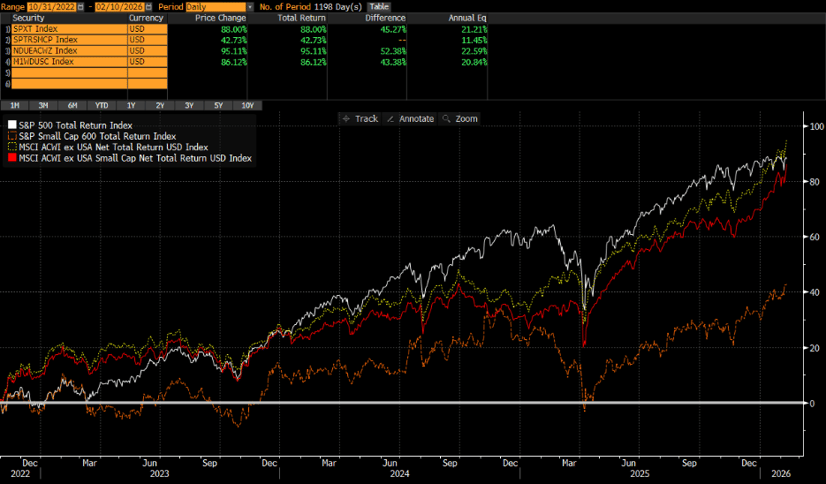
Source: Bloomberg
However, leadership shifted markedly starting in Q4 2025: small-cap laggards have outperformed large-cap leaders across geographies, sectors, and styles. The S&P 500 has now lagged the broader market in a meaningful way.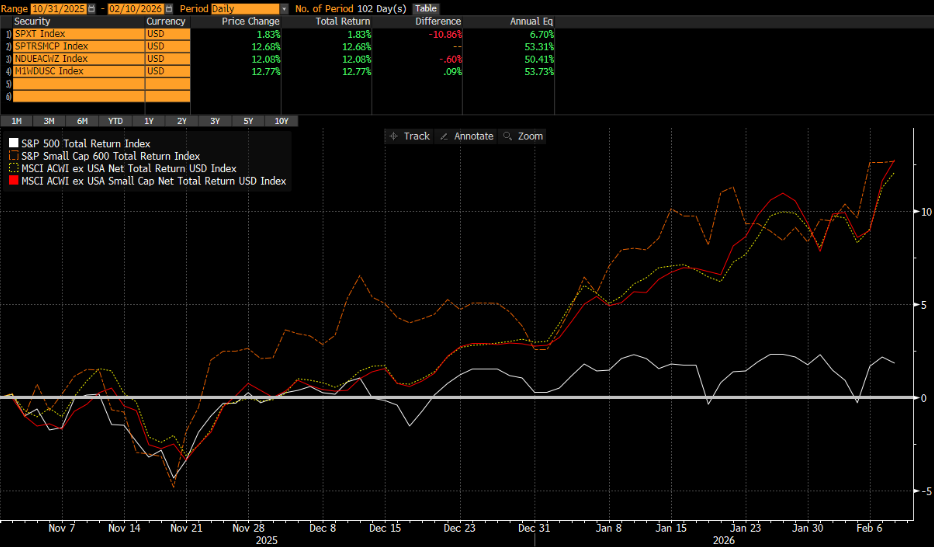
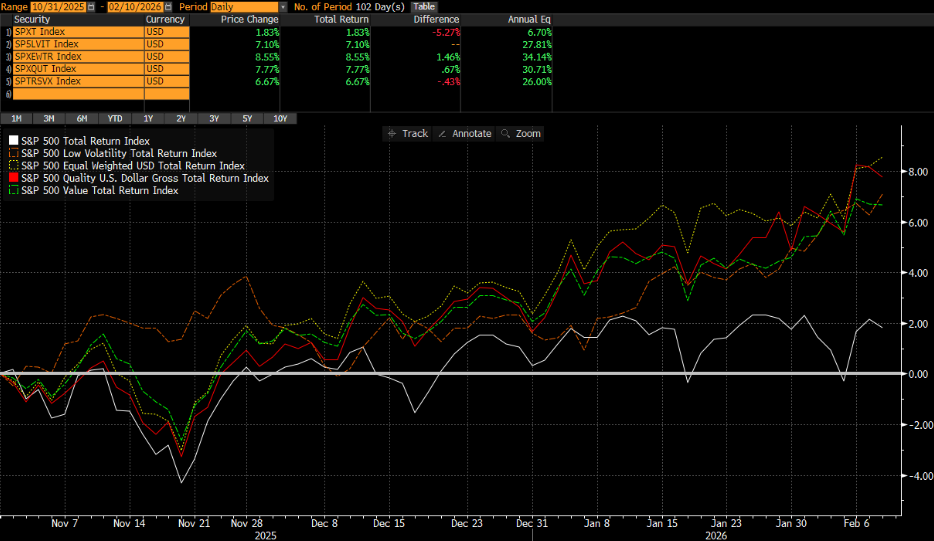
Source: Bloomberg
Is the spirit of Festivus (Frank Costanza's iconic Seinfeld holiday "for the rest of us") finally permeating markets? Are we witnessing a rotation toward companies outside the AI-driven capital expenditure narrative, perhaps in response to active managers' long-standing grievances against passive dominance?
The AI story isn't fading; its effects remain concentrated in narrow pockets, such as surging demand for high-bandwidth memory or the derating of software-as-a-service (SaaS) valuations. Investors are reevaluating inelastic end-customer demand, potentially favoring affordable add-ons (e.g., new AI tools like Claude) over premium SaaS subscriptions.
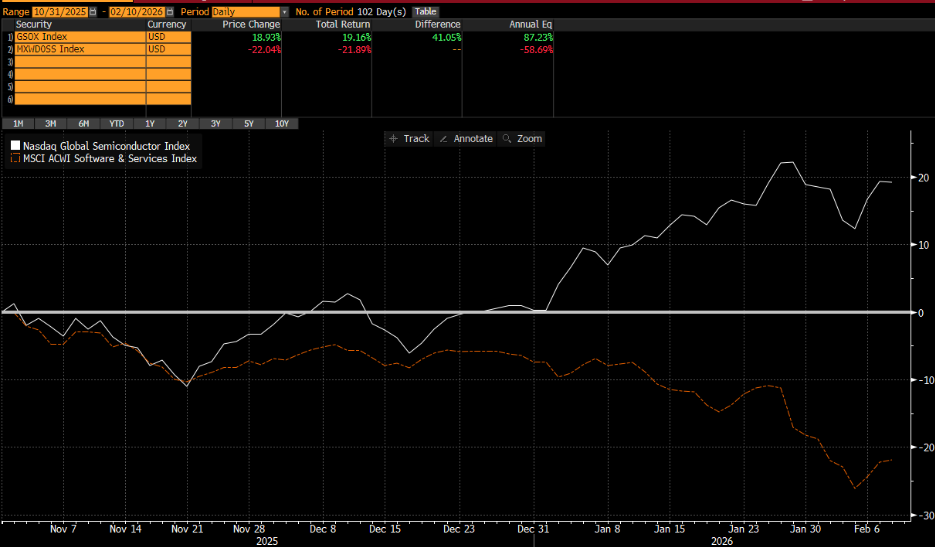
Source: Bloomberg
That said, rising AI-driven productivity could lift all boats. Anthropic's research estimates current-generation models could boost U.S. labor productivity growth by ~1.8% annually over the next decade (roughly double recent trends), assuming widespread adoption. This assumes the $3–4 trillion in projected data-center capex gets financed, privately or via government industrial policies.
Markets have already priced in much of the AI upside, bidding up everything from industrial metals to non-computing infrastructure (e.g., gas turbines, modular building). Yet pockets of the equity universe have lagged this cycle's strength, amplified by U.S. tax policies and computing breakthroughs. Two stand out:
1. Global Real Estate Investment Trusts (REITs).
According to CRE Daily, “the global real estate market enters 2026 with improving fundamentals, falling new supply, and valuations near historic lows…” as a “a decline in new construction across most major property types is restoring pricing power, while resilient demand supports growth in rents and earnings.”
From a valuation perspective, “global REITs are priced at a 17% discount to intrinsic value, with U.S. REITs leading the divergence. Forward P/FFO (funds from operations) ratios have compressed significantly since 2021, and REITs now trade at their lowest price-to-cash-flow multiples relative to equities in nearly 20 years.”
The Bloomberg TLTS factor lens confirms the forward outlook as global REITs (proxied by the iShares Global REIT ETF), as the sector enjoys historically low valuations and high dividend yields over the trailing 5 years. Quality metrics are at the lower end, but this could reflect the narrowing profitability as the real estate sector has had to contend with higher financing costs amid shrinking demand during the post-pandemic period. However, overall risk (volatility) has dropped and the forward growth metric has improved. Real estate should also enjoy monetary policy tailwinds as global central banks move further beyond the rate hike cycle from 2021-2022.
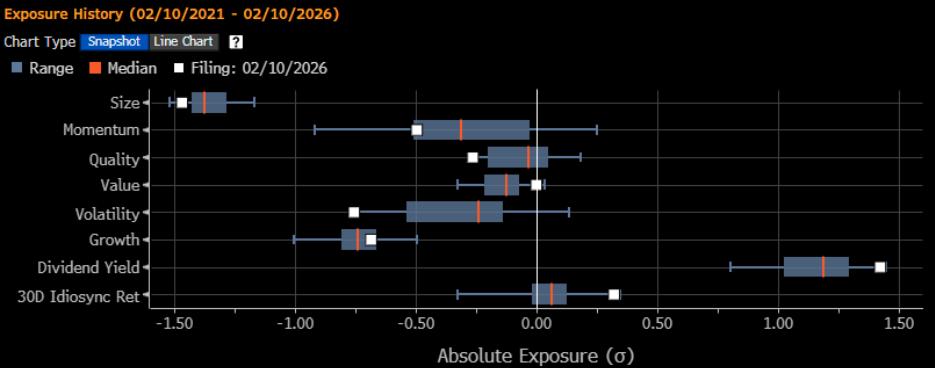
Source: Bloomberg TLTS profile of iShares Global REIT ETF
2. Upstream and Downstream Natural Gas.
Macro strategists (e.g., Michael Kao, Larry MacDonald) highlight structural demand drivers: electrification for data-center buildouts, evolving views on gas vs. other hydrocarbons, and rising LNG needs in Asia and Europe.
The EIA forecasts U.S. dry natural gas production growing ~2% in 2026 (to ~110 Bcf/d) and ~1% in 2027, while global demand accelerates to ~2% growth in 2026, led by Asia's
1 https://www.credaily.com/briefs/2026-a-turning-point-for-reits/
electrification push and Europe's shift away from Russian supplies. Data centers increasingly adopt "behind-the-meter" gas access to avoid grid strain, boosting midstream prospects. Though near-term supply surpluses persist, they could vanish by 2030 if key markets (China, India) raise gas's share in their energy mixes.
Bloomberg's TLTS lens for the S&P Commodity Producers Oil & Gas Exploration Index (a proxy) shows strong value orientation, with improving quality from greater producer capital discipline. Sector multiples could re-rate from cyclical lows toward higher levels on secular growth tailwinds.
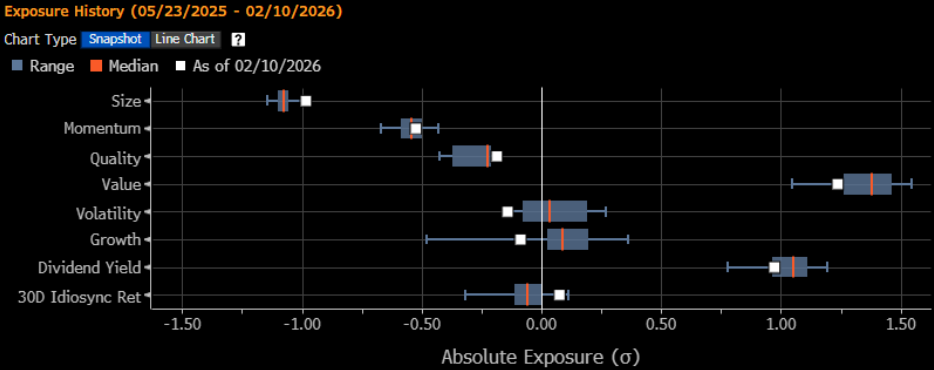
Source: Bloomberg TLTS profile of the S&P Commodity Producers Oil and Gas Exploration Index
In summary, hard assets and AI-infrastructure plays have surged in recent years amid low recession odds, even as broader demand softens in spots. Yet real estate and energy infrastructure now offer compelling entry points as the "rest of the market" catches up to the AI capex narrative, potentially ushering in a true broadening of leadership.

*Fractional shares are not available at every custodian.


 860-291-1998
 Schedule Demo